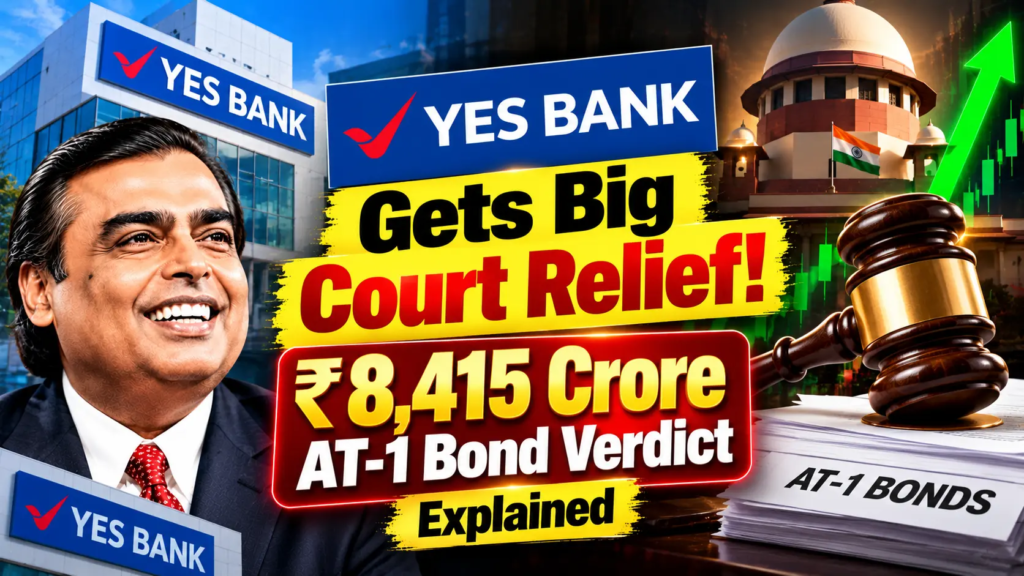
YES Bank News: A major legal development has brought YES Bank’s ₹8,415 crore AT-1 bond dispute back into focus. On October 28, 2026, the Supreme Court dismissed appeals filed by YES Bank, the Reserve Bank of India (RBI) and the Union Government, upholding the Bombay High Court’s decision against the permanent write-down of the bank’s AT-1 bonds.
The ruling is significant for bondholders and investors tracking YES Bank. But does this decision mean the bank’s shares could rise? Will bondholders get their money back? And what should new investors understand about this development? Here is a simple explanation of the case and its possible implications.
YES Bank’s ₹8,415 Crore Bond Case: What Happened?
The dispute concerns Additional Tier-1 (AT-1) bonds worth ₹8,415 crore that were permanently written down during YES Bank’s 2020 reconstruction process.
The Bombay High Court had set aside the write-down, and the Supreme Court has now upheld that decision by dismissing the appeals.
The disputed bonds were issued in two tranches:
| Details | Amount |
|---|---|
| First tranche | ₹3,000 crore |
| Second tranche | ₹5,415 crore |
| Total disputed bonds | ₹8,415 crore |
The case centres on whether the permanent write-down was legally permissible under the final YES Bank Reconstruction Scheme, 2020.
Why Did the Supreme Court Uphold the Verdict?
One of the key issues was the wording of the final reconstruction scheme.
According to the ruling, the scheme did not contain a specific provision authorising the administrator to permanently write down the AT-1 bonds in the manner challenged in court.
The Supreme Court therefore upheld the Bombay High Court’s decision setting aside the write-down.
The verdict highlights the importance of following the applicable legal framework and the terms of a bank’s reconstruction scheme when dealing with financial instruments such as AT-1 bonds.
What Are AT-1 Bonds? A Simple Explanation for New Investors
AT-1 bonds are financial instruments that banks use to strengthen their regulatory capital. They are different from fixed deposits and carry substantially different risks.
Depending on the applicable rules and bond terms, AT-1 bondholders may face coupon-payment risks, restrictions on payments or losses to their principal during periods of financial stress.
This is why AT-1 bonds should not be treated as equivalent to ordinary bank deposits.
Important for beginners: A higher interest rate does not automatically mean a safer investment. Understanding the terms, risks and conditions of a financial instrument is essential before investing.
Will YES Bank Shares Rise After the Supreme Court Verdict?
This is likely to be one of the biggest questions among stock market investors.
The Supreme Court decision is an important legal development, but it does not automatically guarantee a rise in YES Bank’s share price.
The stock’s performance will also depend on several factors, including:
- Profitability: Whether the bank can sustain and improve its earnings.
- Asset quality: Trends in gross and net non-performing assets (NPAs).
- Business growth: Changes in deposits, lending and other banking operations.
- Valuation: Whether the current share price adequately reflects the bank’s financial position and risks.
- Financial impact of the verdict: How the ruling is implemented and what effect it has on the bank’s financial statements.
A favourable legal development can influence market sentiment, but investors should avoid assuming that one court ruling will determine the stock’s future direction.
Will AT-1 Bondholders Get Their Money Back?
The verdict is significant, but investors should distinguish between setting aside a bond write-down and receiving an actual payment.
The ruling does not, by itself, establish that every bondholder will immediately receive the full principal amount. The practical outcome may depend on the implementation of the judgment, the relevant bond terms and any applicable legal process.
The case also involves annual coupon payments. According to the details of the dispute, those payments were to remain unaffected by the outcome of the appeals and be made in accordance with the relevant Information Memoranda.
Bondholders should therefore review the official judgment and the terms applicable to their particular instruments to understand the implications for principal and coupon payments.
What Does This Verdict Mean for YES Bank Investors?
The decision puts the bank’s AT-1 bond dispute back in focus and raises important questions about the rights of investors holding complex financial instruments.
However, the legal outcome should be assessed separately from YES Bank’s overall financial performance.
For equity investors, the bank’s earnings, asset quality, capital position, business growth and valuation remain important considerations. For AT-1 bondholders, the legal terms and implementation of the judgment are particularly relevant.
New investors should also remember that a headline about a major court victory does not necessarily translate into immediate financial gains.
Key Takeaways From the YES Bank Supreme Court Verdict
- The Supreme Court dismissed appeals by YES Bank, RBI and the Union Government.
- The Bombay High Court’s decision against the permanent AT-1 bond write-down was upheld.
- The dispute involves bonds worth ₹8,415 crore.
- The ruling does not automatically guarantee an immediate repayment of the entire principal to every bondholder.
- The verdict alone does not guarantee a rise in YES Bank’s share price.
Conclusion
The Supreme Court’s decision in the ₹8,415 crore YES Bank AT-1 bond case marks a significant legal development for the bank and the investors affected by the dispute.
The next important questions concern the practical implementation of the judgment and its implications for the bondholders involved. Equity investors, meanwhile, will need to assess the bank’s financial performance alongside this legal development.
For new investors, the key lesson is simple: understand the difference between a legal victory, a company’s financial performance and the potential movement of its share price.
Read Also : Vodafone Idea Share Price Target: Jefferies Sees ₹29 in Bull Case, Cuts Base Target to ₹16
Disclaimer: This article is for informational and educational purposes only and does not constitute investment advice or a recommendation to buy or sell any security. Investors should review official disclosures and consider their individual risk tolerance before making financial decisions.