
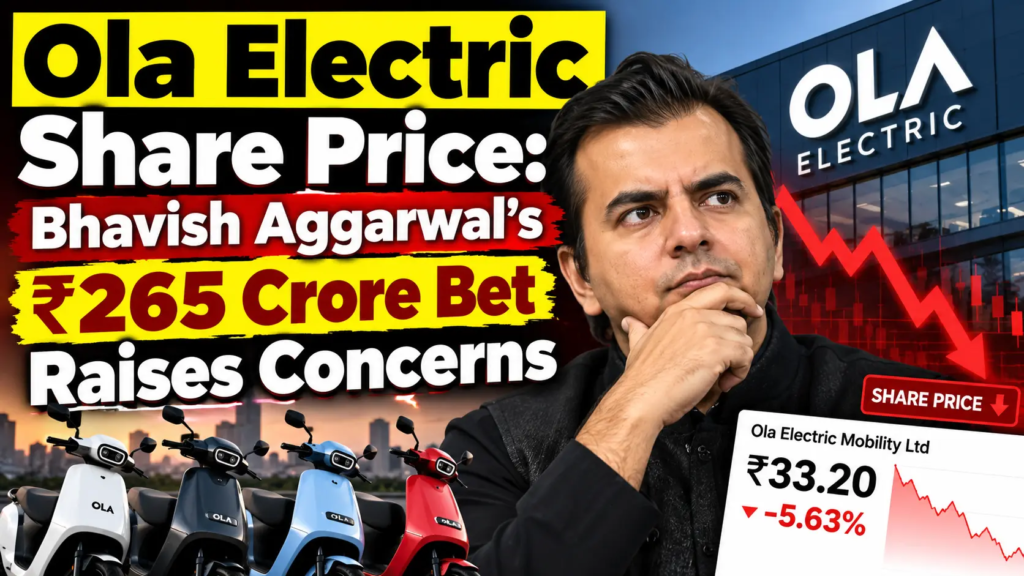
Ola Electric Mobility Ltd is back in focus after founder Bhavish Aggarwal used pledged shares to arrange funds for his participation in the company’s ₹1,000 crore rights issue. Despite the successful fundraising, falling revenue, heavy losses and weak operating performance remain major concerns for investors.
₹1,000 Crore Rights Issue Gets Fully Subscribed
Ola Electric’s ₹1,000 crore rights issue received a positive response from investors and was fully subscribed on October 28, two days before the closing date.
The company offered approximately 37.03 crore partly paid-up equity shares at an issue price of ₹27 per share. Investors submitted applications for around 37.14 crore shares, taking subscriptions beyond the total number of shares on offer.
The successful fundraising comes at an important time for the electric vehicle manufacturer, which has been dealing with declining sales, financial losses and pressure to improve its market position.
According to reports, the funds raised through the rights issue are intended to support the company’s financial requirements, including debt repayment and business expansion.
Bhavish Aggarwal Pledges 20 Crore Shares: What Is the Funding Arrangement?
The biggest talking point surrounding the rights issue is the funding arrangement made by Ola Electric founder and promoter Bhavish Aggarwal.
Aggarwal committed approximately ₹265.14 crore to subscribe to his full rights entitlement. However, instead of relying entirely on available funds, he used his Ola Electric shareholding as collateral to arrange financing.
According to regulatory and debt records reported by Moneycontrol, Krutrim Data Centre Pvt Ltd, a promoter-group entity, raised ₹175 crore through non-convertible debentures.
The borrowing included:
- ₹150 crore raised from InCred Special Opportunities Fund I.
- ₹25 crore raised from Avendus Finance.
- An annual coupon rate of 17.15%.
- Maturity scheduled for September 30, 2029.
To support the financing, Aggarwal pledged 20 crore Ola Electric shares, representing approximately 4.32% of the company’s equity.
The borrowing arrangement also includes a personal guarantee from Aggarwal and a charge over certain assets of Krutrim Data Centre.
Importantly, Krutrim Data Centre is a promoter-group entity and is different from the AI company Krutrim SI Designs.
The arrangement highlights the financial commitment being made by the founder, but it also brings borrowing costs and collateral-related risks into the picture.
Why Is the 17.15% Interest Rate Important?
The cost of borrowing is another factor investors may want to examine.
A coupon rate of 17.15% is relatively expensive financing. It means the borrowing carries a substantial interest burden, although the actual financial impact will depend on the outstanding amount, payment terms and other conditions.
There is another important detail.
Aggarwal’s total rights subscription commitment stands at approximately ₹265.14 crore. However, only ₹16.20 per share was payable at the application stage, while the remaining ₹10.80 per share is expected to be paid through a subsequent call.
The upfront requirement for his entitlement was approximately ₹159.08 crore, with another ₹106.06 crore payable later.
This distinction matters because the ₹175 crore borrowing should not be confused with the full ₹265 crore rights subscription commitment.
For investors, the key question is whether the company’s business performance can improve sufficiently to justify the financial commitments being made by its promoter.
Ola Electric Financial Performance: Revenue Remains Under Pressure
Ola Electric’s financial numbers present a challenging picture.
The company’s consolidated financial performance shows that revenue has fallen sharply from its earlier levels.
According to the financial figures available for FY2026 and the June 2026 quarter, here are some important numbers:
| Financial Metric | FY2025 | FY2026 |
|---|---|---|
| Revenue | ₹4,514 Cr | ₹2,253 Cr |
| Operating Loss | ₹1,735 Cr | ₹978 Cr |
| Net Loss | ₹2,276 Cr | ₹1,833 Cr |
| Borrowings | ₹3,556 Cr | ₹2,763 Cr |
| Free Cash Flow | -₹3,367 Cr | -₹1,492 Cr |
The numbers show two different developments.
On one hand, the company has reduced its annual operating loss and net loss compared with FY2025. Borrowings have also declined.
On the other hand, revenue has nearly halved, indicating that improving profitability remains a difficult task.
The company continues to report negative operating margins and negative returns on capital.
June 2026 Quarter: Revenue at ₹455 Crore
Ola Electric’s June 2026 quarter reported consolidated revenue of ₹455 crore, compared with ₹828 crore in the June 2025 quarter.
That represents a decline of approximately 45% year-on-year.
The company reported a net loss of ₹336 crore, against a loss of ₹428 crore in the corresponding quarter last year.
While the loss has narrowed, revenue contraction remains a major concern.
Investors will need to watch whether the company can improve deliveries, increase revenue and bring down operating costs in the coming quarters.
Share Price Performance: Ola Electric Stock Remains Volatile
Ola Electric shares have experienced significant volatility in the stock market.
As per the supplied market data, the stock closed at ₹33.20 on October 30, 2026, down 5.63% for the session.
The stock has a 52-week high of ₹50.90 and a 52-week low of ₹20.80.
Its market capitalisation stands at approximately ₹16,586 crore.
The stock also witnessed a sharp recovery around the rights issue announcement. On October 28, shares closed at ₹36.66 after gaining approximately 23% over two trading sessions.
However, the subsequent decline indicates that investors are still assessing the company’s financial outlook.
The successful completion of a fundraising exercise does not automatically mean that the underlying business has recovered.
Shareholding Pattern: Promoter Holding at 32.96%
Another important factor is the company’s shareholding structure.
According to the September 2026 shareholding data, the promoter group held approximately 32.96% of Ola Electric.
The remaining ownership was distributed as follows:
| Investor Category | Holding |
|---|---|
| Promoters | 32.96% |
| FIIs | 4.73% |
| DIIs | 11.75% |
| Public | 46.04% |
| Others | 4.51% |
The promoter holding has declined from 36.78% in September 2024.
Meanwhile, domestic institutional investors increased their holding from 7.01% in March 2026 to 12.16% in June 2026, before it stood at 11.75% in September 2026.
These changes are worth monitoring, although institutional buying or selling alone should not be treated as a signal of future stock performance.
Ola Electric’s Business Strategy: Can the Company Regain Its Position?
Apart from fundraising, Ola Electric needs to address operational challenges.
The company has been moving towards a dealer-network-driven sales model instead of relying entirely on its direct-to-consumer approach.
This change is significant because distribution and after-sales service are important factors in the electric two-wheeler market.
Customers generally consider several things before purchasing an electric scooter:
- Vehicle price and battery performance.
- Service centre availability.
- Spare parts availability.
- Warranty and replacement support.
- Resale value and reliability.
Ola Electric needs to strengthen these areas if it wants to rebuild customer confidence and improve sales.
Competition from established manufacturers such as TVS Motor, Bajaj Auto, Hero MotoCorp and newer EV companies such as Ather Energy makes the task even more challenging.
The company also has to demonstrate that its manufacturing capabilities and battery technology can translate into sustainable revenue and better operating margins.
What Should Investors Watch Going Forward?
There are several important factors that could influence Ola Electric’s future financial performance and share price.
1. Revenue Growth: Investors should watch whether quarterly revenue starts recovering after the sharp decline.
2. Reduction in Losses: A sustainable reduction in operating losses would be more meaningful than temporary improvements in reported net losses.
3. Debt and Interest Costs: The company needs to manage its borrowing obligations and improve its financial position.
4. Vehicle Deliveries: Higher registrations and improved market share would indicate a possible recovery in customer demand.
5. Service Network: Better after-sales support could help the company rebuild customer confidence.
6. Cash Flow: Improving operating cash flow is essential to reduce dependence on external fundraising.
7. Promoter Pledge: Investors should monitor future disclosures concerning pledged shares and any changes in promoter shareholding.
Stock Fundamental Analysis Table
| Particulars | Values |
|---|---|
| Market Cap | ₹17,511 Cr. |
| Current Price | ₹35.00 |
| High / Low | ₹50.90 / ₹20.80 |
| Stock P/E | Not Available |
| Book Value | ₹7.46 |
| Dividend Yield | 0.00% |
| ROC | -19.9% |
| ROE | -43.2% |
| Face Value | ₹10.00 |
| Sales | ₹1,880 Cr. |
| Debt | ₹2,763 Cr. |
| Sales Growth | -49.2% |
| Profit After Tax (PAT) | -₹1,741 Cr. |
| Return Over 3 Years | Not Available |
| Debt to Equity | 0.82 |
| Return on Equity (ROE) | -43.2% |
| Promoter Holding | 33.0% |
| EV/EBITDA | -24.9 |
| Industry P/E | 27.9 |
| Profit Variation (3 Years) | -11.8% |
| Sales Growth (3 Years) | -5.04% |
| Price to Earnings (P/E) | Not Available |
| Return Over 3 Months | -7.58% |
| Return Over 6 Months | +2.40% |
| Current Ratio | 1.14 |
| Enterprise Value | ₹18,732 Cr. |
| Profit Growth | +26.1% |
Final Takeaway: Is Ola Electric Ready for a Turnaround?
Ola Electric has secured an important financial lifeline through its ₹1,000 crore rights issue. Bhavish Aggarwal’s participation also demonstrates a significant financial commitment from the founder.
However, the company’s challenges go beyond raising money.
Falling revenue, continuing losses, negative operating margins and expensive promoter-linked financing are important factors that investors cannot ignore.
The next phase will be about execution rather than fundraising announcements.
If Ola Electric manages to improve vehicle sales, strengthen its service network, reduce operating losses and generate healthier cash flows, the business could gradually move towards a recovery.
But until these improvements become visible in its financial results, investors should carefully evaluate the risks rather than make decisions based only on short-term share price movements.
Read Also : Ashutosh Fibre Shares Rebound After 30% Fall; Veteran Investor Vijay Kedia Holds 10.35 Lakh Shares
For now, Ola Electric remains a high-risk business turnaround story, and its financial performance in the coming quarters will be crucial.
Disclaimer: This article is for informational and educational purposes only. It is not investment advice or a recommendation to buy or sell Ola Electric shares. Investors should conduct independent research and consider their risk appetite before making investment decisions.


Pingback: Government Stock Announces ₹3 Dividend! Profit Jumps 14%; Check Record Date - khabriuncle.in
Pingback: Reliance Shares Jump 11.6% Today! Can RIL Hit ₹1,800? Deven Choksey Explains the Big Bullish Trigger - khabriuncle.in